

An update:
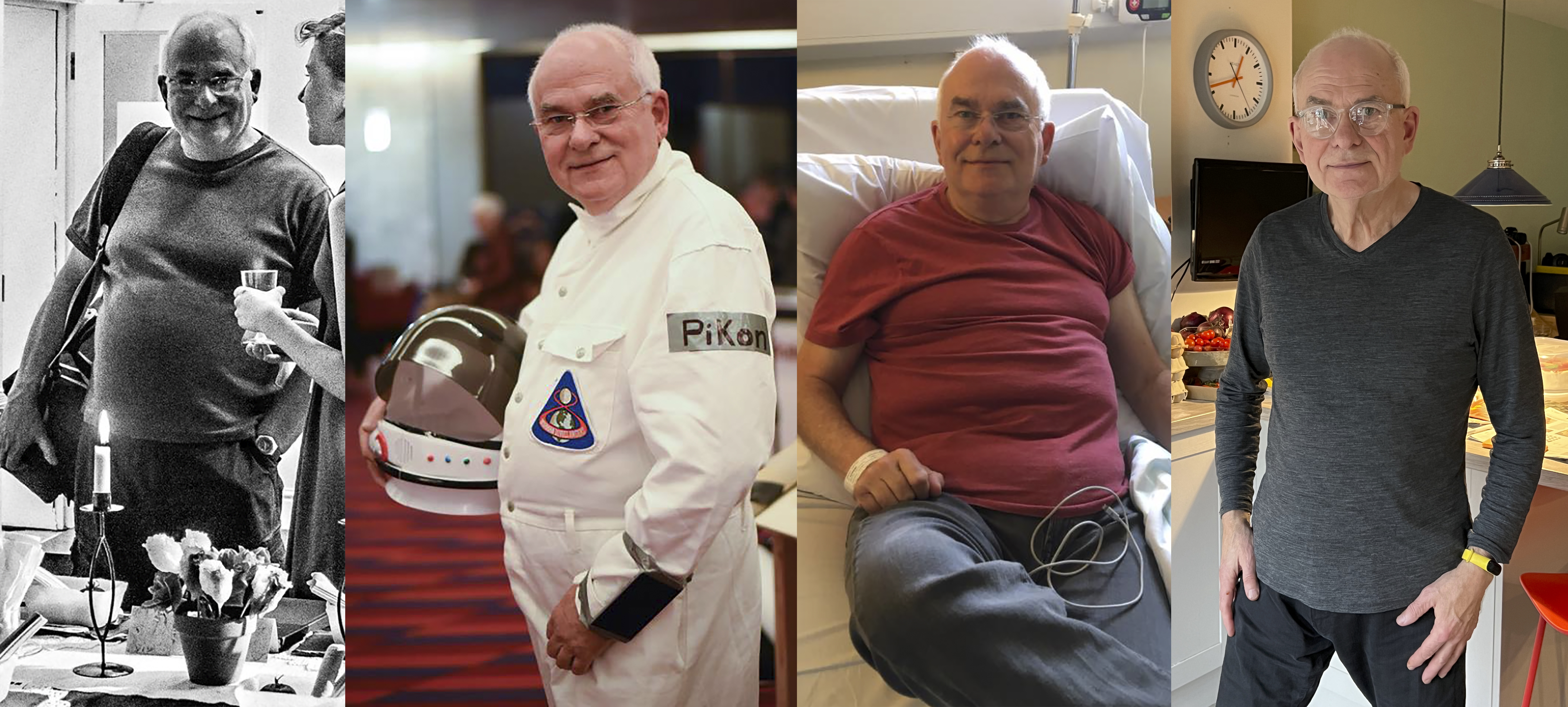
10 years ago I set myself the goal of loosing 30% of body weight and (hopefully) living 10 years longer. More by accident than design, I reached that goal at the end of 2023. From nearly 100 Kg (15.7 stones / 220 lb) to 70kg (11 stones / 154 lb). By accident because at various times I’ve embarked on a diet encouraged by various books. So I thought I’d start this series of articles on diet by listing those diet plans and give a basic overview of each. I have tried them all and from a psychological point of view, I’m the personality type who likes to try something new and innovative. I now use elements and ideas of many to suit my goals.
The F-plan diet (Audrey Eyton, 1982): Basically putting more fibre into your diet and avoiding things where the fibre has been removed. A prime example is orange juice. It sounds healthy but with all the fibre removed it’s flavour and concentrated fruit sugars. The diet was the first time the importance of dietary fibre was recognised in popular diet books.
The Atkins diet (1992): This is a carbohydrate restricted diet which drastically reduces carbs intake and puts the body into ketosis. One benefit being that this suppresses hunger. Much criticised by the medical establishments, elements of this diet are much in line with the control of type II diabetes. The plan has evolved and revised editions issued.
The Zone (Barry Sears 1995): The Zone focuses on the balance of calorific intake from macro nutrients. I.e. carbohydrates, protein and fats. It advocates roughly 1/3 from each.
Slimming World (today): Slimming World controls calorific intake by a system of “syns”. A number of daily syns are allowed per day along with some basic food allowances. High food syns are associated with calorie dense foods, especially those containing fats. Slimming World offers a U.K. network with weekly weigh ins and motivational group sessions.
Fasting:
In recent years there has been an emphasis on fasting or very low calorie days. This is of particular interest to those combating type II diabetes. Noticeable authors are:
Micheal Mosley, Roy Taylor, Jason Fung.
5/2 Diet: Initially advocating 2 days per week of calorie intake restricted to 500 Kcals and later relaxed to 800 Kcals.
Fast 800: Initial rapid wight loss by daily calorie restriction to 800 Kcals for a period of 2 months. A similar regime is available from the National Health Service to address type II diabetes using formula shakes for an initial rapid weight loss. Age and body mass index (BMI) requirements apply.
Intermittent Fasting: Abstaining from food intake (but not water, black tea and coffee) for periods of 12, 16, 14, 36 hours. 36 hour fasts are sometimes called alternate day fasting.
Extended Fasting: (Only to be undertaken under medical supervision): Abstaining from food for periods of 4 to 14 days.
I’ll be exploring these diets in more detail and describing my progress in reversing my type II diabetes. Please leave your email if you’d like updates.
_______________________________________________________________________
I recently posted that I had lost 2 stones / 13 kg on Facebook, and that my BMI is now within the NHS normal range. A lot of people were very kind and encouraging and some asked me what I did.
My motivation for loosing weight has come from developing type 2 diabetes and a worsening HbA1c blood count. It’s an event that has made me look at life style and what I could possibly do to avoid the worsening symptoms of this very common, western condition. The NHS sent me on a DESMOND education course where I was given information that I knew to be false. In some ways, this helped because I have a rebellious ‘I know better’ personality trait which motivated me to read up on the subject. I wanted to take control of this situation and not be told what to do by professionals who had presided over an obesity epidemic.
So, here’s my strategy for weight loss and I have tried to rank things as most important to me.
1 – Psychology
Most important is the right mind set. Without that all the diets and exercise will not help, because you’ll probably give up.
- If you are overweight, there is something in your life style that’s causing it. It’s unlikely to be lack of exercise but more likely something you are habitually eating or drinking. Be honest with yourself. The usual culprit is alcohol but it could be sweets, snacks or sugar addiction.
- You need to think in terms of a sustainable life style. The initial weight loss phase will be harder than this, but when the diet finishes or you get fed up, you need to fall back on something that doesn’t reverse everything.
- You can take a break. It’s not failure. Keep a long term (rest of your life) focus and go back to the weight loss without being discouraged or guilty.
- It will get easier as you progress.
- Don’t get hung up on exercise. It doesn’t cause much weight loss and it’s hard enough to change what you eat without a punishing schedule in the gym aswell. As your weight comes down, exercise will be more enjoyable.
- Forget calories in calories out. It’s only part of the equation.
- Focus on the benefits – maybe and extra 10 years of life expectancy, looking better, felling energised, clothes fitting.
2- Controlling hunger
If you are going to reduce you food energy intake so much that you will loose weight, the chances are that you will feel hungry at times. I think this is more important than the energy value of food because there are some foods which will have you coming back for more.
- Avoid sugar. It is addictive and will cause a strong metal urge to eat more. Some literature suggest a neurological trigger. There are suggestions that even low-cal sweeteners have the same effect.
- Eat (the right kind) of fat. Per gram, fat contains more energy than other food types but it is also satisfying. You will stay satisfied for longer. Virgin olive oil, butter and animal fats are good. I avoid highly refines fats like sunflower oil and vegetable oil.
- You do not need 3 meals a day. Advice about the importance of breakfast has no evidence behind it. I don’t feel hungry in the mornings, so I don’t eat. At the present stage of my diet regime, I am fasting during the day and eating after 7 pm. It’s the easiest way I’ve found to limit my calorific intake. It’s not for life but is causing weight loss at about 1.5kg a week.
- Avoid alcohol. This is a killer! A glass of wine usually ends up with munches and crisps.
- If you are feeling hungry try a drink: coffee, tea, beef broth, ‘bullet coffee’ (black coffee blended with butter).
3 – Avoiding carbohydrates
The human body evolved over millions of years. Agriculture has been around a few thousand years and cheap manufactures foods were invented in the middle of the 20th century. Agriculture has ultimately resulted in high glycemic index carbohydrate foods like sugar and white flour. Manufactured foods are high in carbs, use Fructose, refined vegetable oils and ready prepared meals are loaded with carbs and hydrolysed fats to make them taste good.
My diet almost totally avoids:
- Sugar
- Flour
- Rice
- Potatoes
- Pasta
- Alcohol (sorry, it’s a carb!)
4 – Having good things to eat
Most of what I eat is made from basic ingredients (as opposed to ready / pre-prepared meals). I sometimes break the rule and then go back to the diet if I fancy a pizza or Chinese take away. The other myths worth busting are:
- Dietary cholesterol has little impact on your blood cholesterol levels (being over weight does that).
- Eat fat. Low fat foods leave you feeling hungry. Manufactured low fat foods generally compensate by adding sugar.
- Eat your eggs. After years of misinformation, eggs are a brilliant food, high in protein and very filling.
Everyone has their own favourite foods. Mine are fish, avocados, lentils (Indian Dal especially), and I am increasingly liking green veg and salads.
5 – Checking progress
I can tell if things are going the right by waring a belt! I usually wear a waist belt and it’s probably the best indicator of weight loss as, like many, my excess fat is concentrated around my waist.
I weigh myself at least once a week and record it. Being a geek, I use an Excel sheet and plot progress. I’ve found that my weight can vary by up to 1.5 kg a day, so it’s best to take a long view on trending weight toss.
6 – Exercise
Exercise is important but burning calories in a gym has a small impact on weight loss. Being fit will (I am told) improve your metabolic rate. In my terms this means that not being worn out all the time will mean that you move more. I’ve noticed that exercise becomes more enjoyable as I loose weigh. At present that means walking more.
Conclusion – These are the basics. There are a lot of nutters out there with magic solutions. The above works for me. I would encourage anyone to go and find out for themselves. As in any subject with a lot of diverse opinions, the best thing is to read up a lot and work out a plan that suits you.
If you’d like to follow this series of article please leave your email:
 Mark Wrigley